
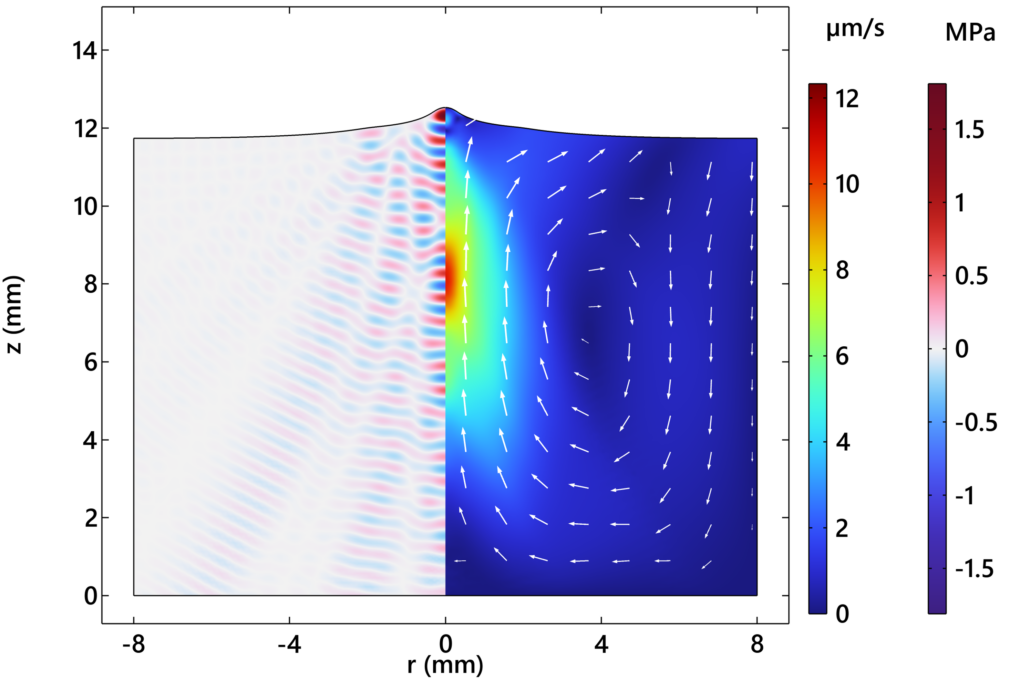
FEM is a versatile numerical tool to solve any partial differential equation, for example the wave equation. FEM is widely used both in academic research and the industry to study and solve complex real-world problems. We use FEM in basic research to study complex phenomena such as nonlinear acoustics, to understand the physical phenomena that are involved in experiments, to design experiments and to optimize devices and processes.
We have various projects where we have involved FEM modelling:
The levitator
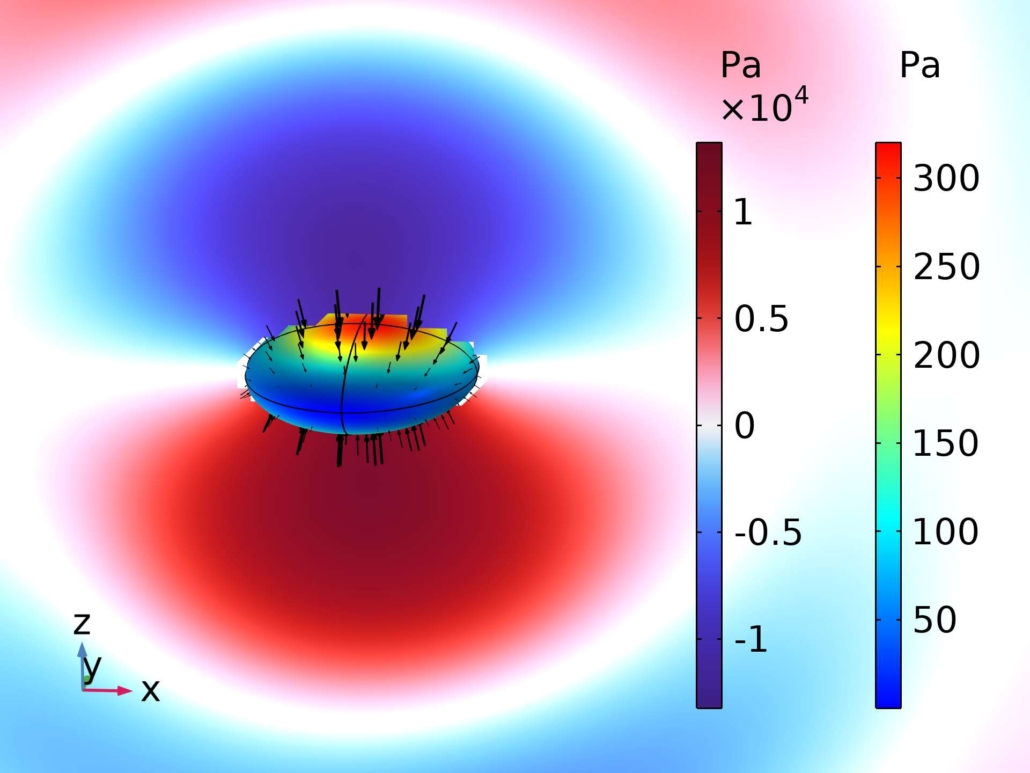
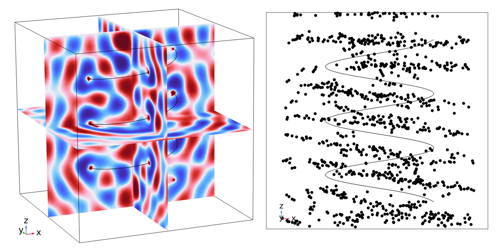
- We model the acoustic field, its scattering from levitating objects and the levitating object dynamics
- “Simulating Acoustic Orientation Trapping for Stable Levitation“, 2019 IEEE International Ultrasonics Symposium (IUS) (2019), P. Helander et al.
UIMAS
- Transducer and subsequent focusing ultrasound modelling are used for designing the process. We also do nonlinear acoustics modelling to understand the more complex phenomena involved namely acoustic streaming.
USES
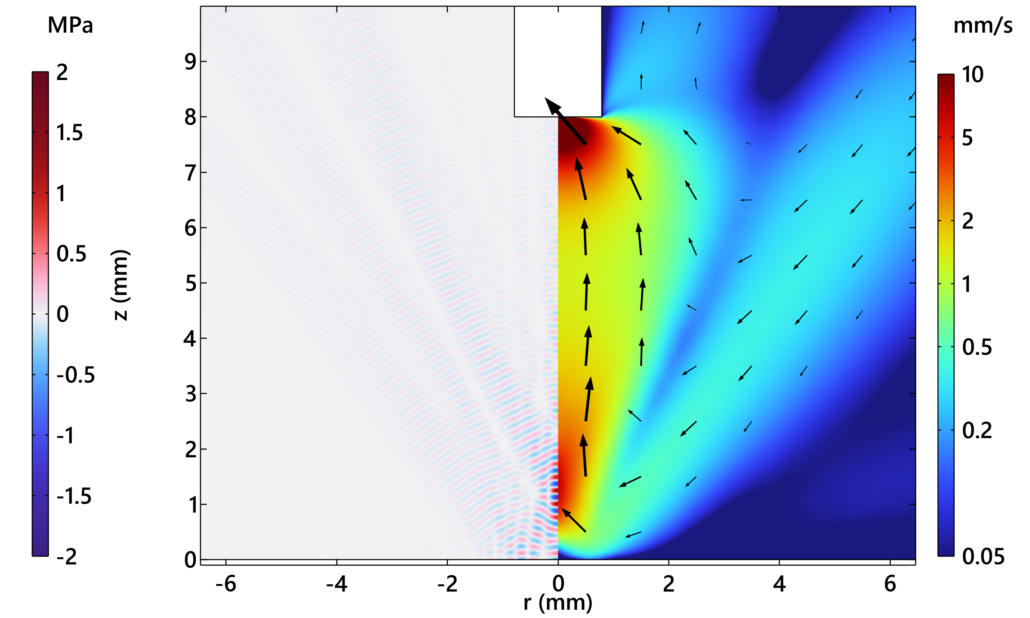
- In USES we utilize FEM in understanding the complex nonlinear phenomena that are involved, currently we are researching acoustic fountain formation and acoustic streaming via simulations.
Oleogels
- In oleogel design we use FEM to model complex shaped acoustic fields and also the nonlinear phenomena involved including radiation forces on small particles.
-
“Practical scale modification of oleogels by ultrasonic standing waves“, Ultrasonics Sonochemistry (2022), P. Lassila et al.
-
“Controlling oleogel crystallization using ultrasonic standing waves“, Scientific Reports (2020), F. Valoppi et al.
Laser acoustics
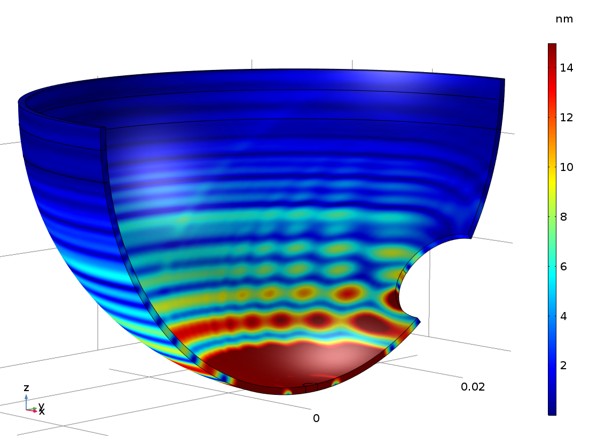
- Here we have utilized FEM to better understand our experimental results. The complexity in analyzing experimental data arises from broadband, multimodal, excitation of guided wave modes in our case, which can be hard to identify from a limited amount of experimental data. Here FEM is used to model the experiment and compare our findings which has helped us identify what we actually see in our experiments.
-
“Defect localization by an extended laser source on a hemisphere“, Scientific Reports (2021), D. Veira Canle et al.
Ultra AI
- In ultra AI we are interested in combining experimental data with AI based data-analysis. For example, we have studied (fouling) localization such that experimental data is fed to an AI which then detects the locations. We have used FEM to again better understand complex scattering phenomena which leads to the signals that are fed to the AI. Currently, we are studying fouling localization and FEM helps us identify how fouling affects the propagating waves and helps us better understand what we see in our experiments.
- “Localizing a target inside an enclosed cylinder with a single chaotic cavity transducer augmented with supervised machine learning“, AIP Advances (2021), T. Sillanpää et al.
Time-reversal
- We have also modelled a lot of time-reversal (TR) acoustics where we can easily test the applicability of the TR approach in confined geometries and with realistic ultrasound transducers.
-
“FEM-based time-reversal enhanced ultrasonic cleaning“, Ultrasonics Sonochemistry (2021), J. Mustonen et al.
-
“FEM-based time-reversal technique for an ultrasonic cleaning application“, Applied Acoustics (2022), O. Tommiska et al.
Metamaterial lens design
- We also use FEM as a tool to design acoustic metamaterial lenses which can then be verified with experiments.
-
“Practical realization of a sub-λ/2 acoustic jet“, Scientific Reports (2019), D. Veira Canle et al.
Contact: M.Sc. Doctoral researcher Joni Mäkinen
joni.mk.makinen[at]helsinki.fi